

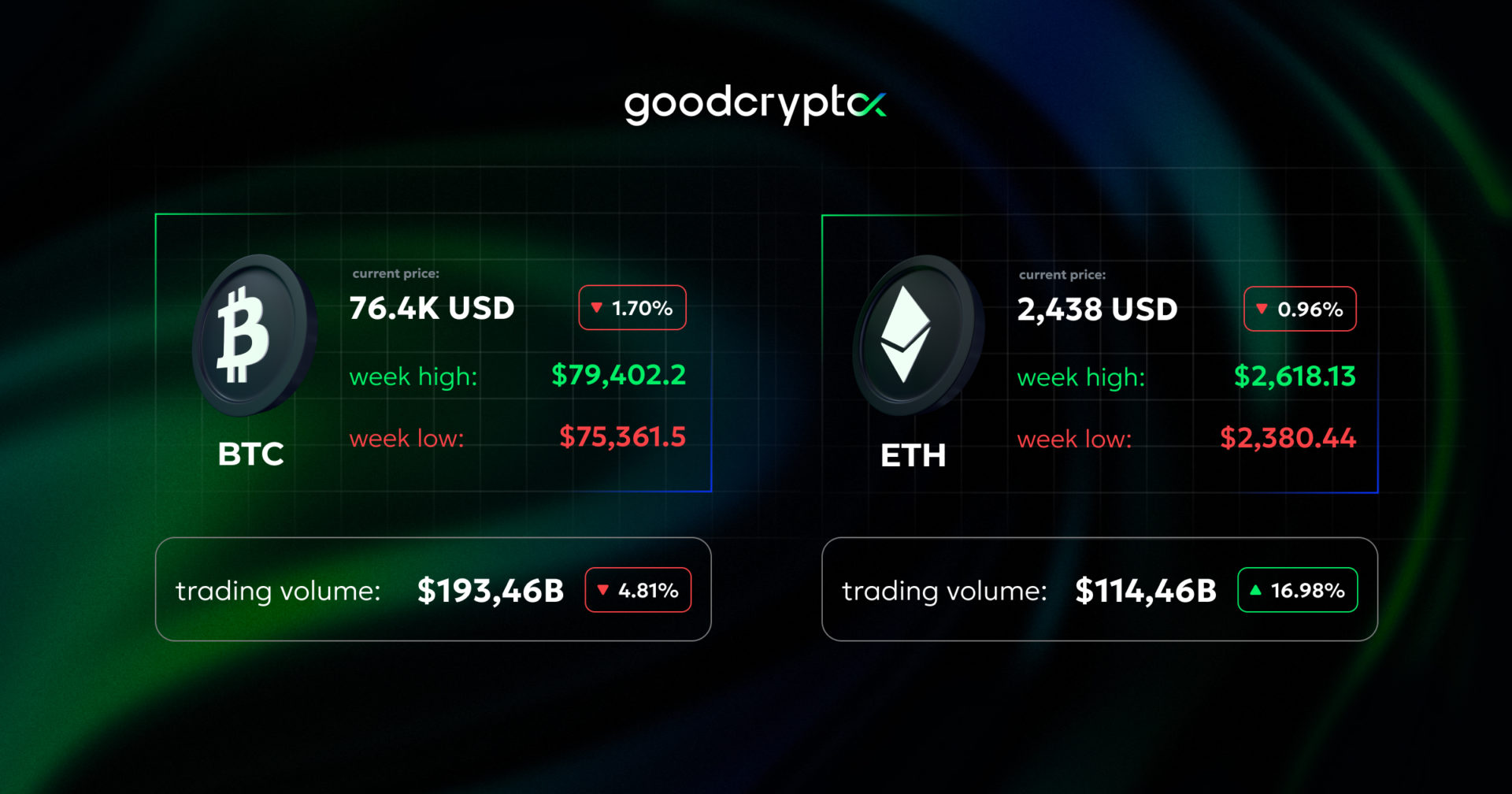
Hey there! 👋
The Fed finally moved, the Senate didn’t, and Circle made the boldest bet of its history. A week that will be remembered. Here’s what happened:
quick weekly news
Zcash leads a broad crypto rally with a 23% surge despite Fed rate hike
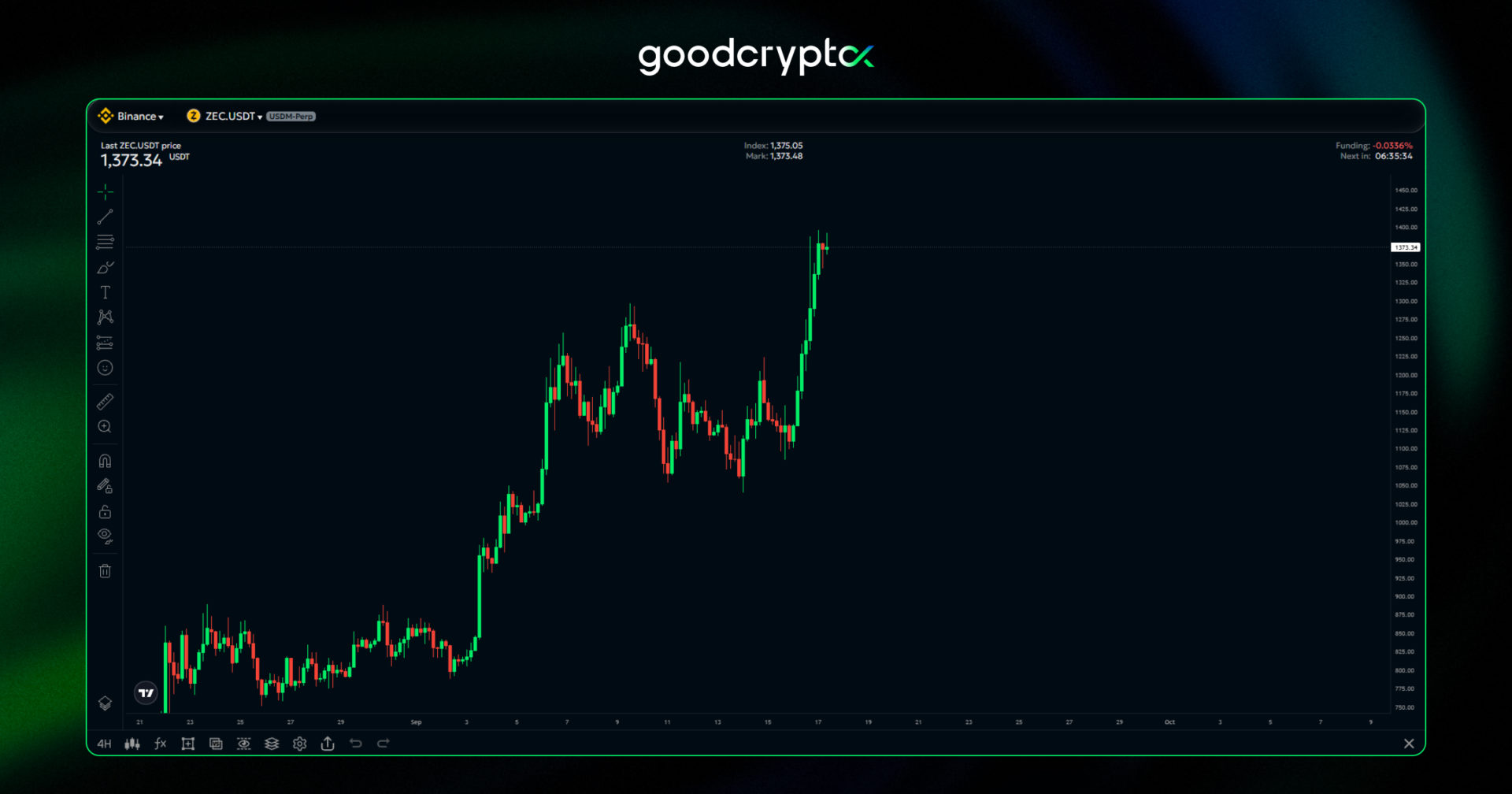
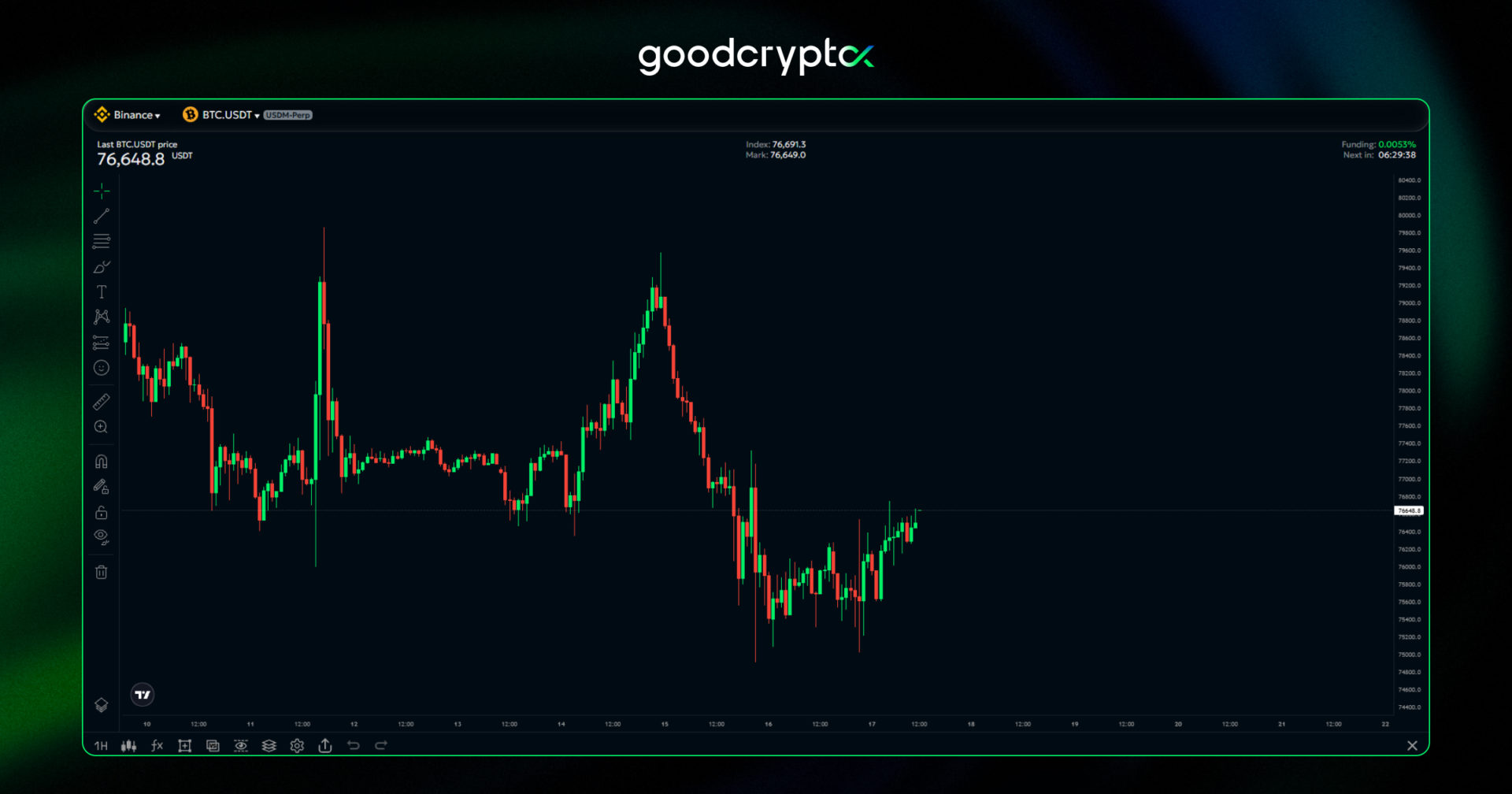
Privacy token Zcash surged 23% over 24 hours to around $1,396, leading a broad crypto recovery that came alongside the Fed’s first rate hike since 2023. Bitcoin edged up less than 1% to $76,258, SOL gained nearly 3% to just below $100, and BNB and HYPE each added more than 2%. ETH, XRP, and DOGE rose between 1% and 2%, per goodcryptoX data.
Source: goodcryptoX
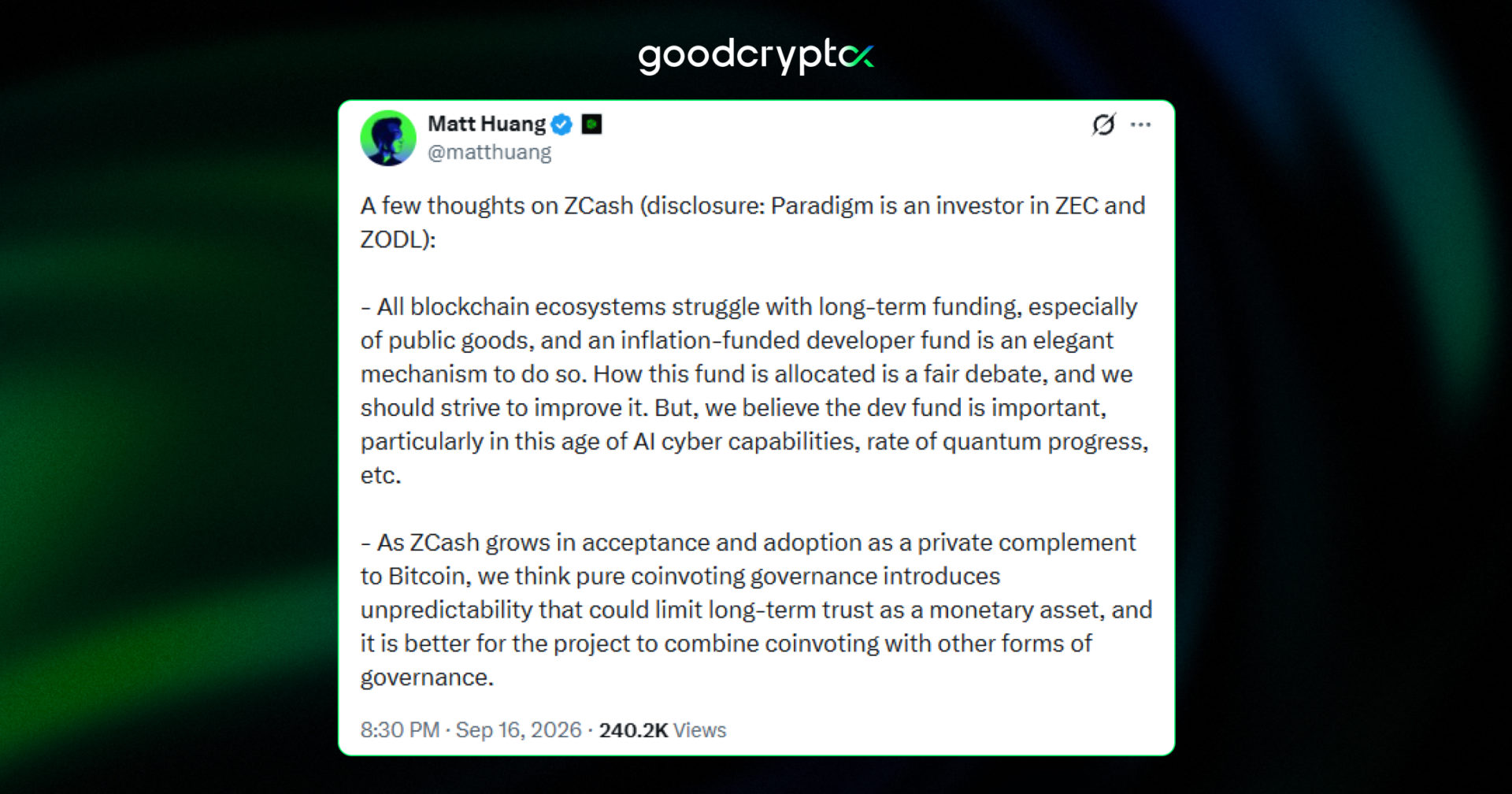
ZEC’s outperformance coincided with comments from Paradigm co-founder Matt Huang, who described Zcash as “a private complement to Bitcoin” and disclosed the firm holds ZEC. Zcash lets users send money without revealing who paid whom or how much, a feature its community recently reinforced with governance votes to maintain scheduled supply cuts while speeding up payments.
Source: X
The broader recovery followed the Fed’s quarter-point hike to 3.75%-4%, which was widely priced in. The Fed’s median projection put the policy rate at 4.1% at the end of both 2026 and 2027, consistent with just one more increase this year, and markets read that as a signal the tightening cycle won’t be aggressive.
Fed raises rates by 25 basis points, its first hike since July 2023
The Federal Reserve raised its benchmark rate by 25 basis points to a range of 3.75%-4% on Wednesday, marking its first hike in more than three years. The vote was unanimous.
The decision lands at an unusual moment for monetary policy. The conflict in the Middle East has kept energy prices elevated and inflation sticky, giving the hawks on the committee enough cover to push for another move even as the economy shows signs of slowing. Chair Kevin Warsh, who put a September hike firmly on the table at Jackson Hole, got what he came for, though the updated projections suggest the committee doesn’t see an aggressive tightening cycle from here.
The Fed’s dot plot puts the policy rate at 4.1% at the end of both 2026 and 2027, implying just one more quarter-point increase before the cycle peaks. That’s a notably more measured signal than the rate path markets had been pricing in through much of August, and it’s likely why risk assets bounced rather than sold off on the news.
Source: goodcryptoX
“Economic activity is expanding at a solid pace,” the FOMC said in its statement. “While uncertainty remains elevated owing, in part, to geopolitical developments, domestic spending has been resilient. Inflation remains elevated. Today’s policy action will support a timelier return to the Committee’s 2 percent goal. The Committee will deliver price stability.”
The CLARITY Act fails in a U.S. Senate vote
The Digital Asset Market Clarity Act fell short in the Senate on Tuesday, failing a 49-50 procedural vote that needed 60 supporters to advance. The loss came despite years of lobbying, hundreds of millions in industry spending, and more than 600 pages of bipartisan legislative compromise.
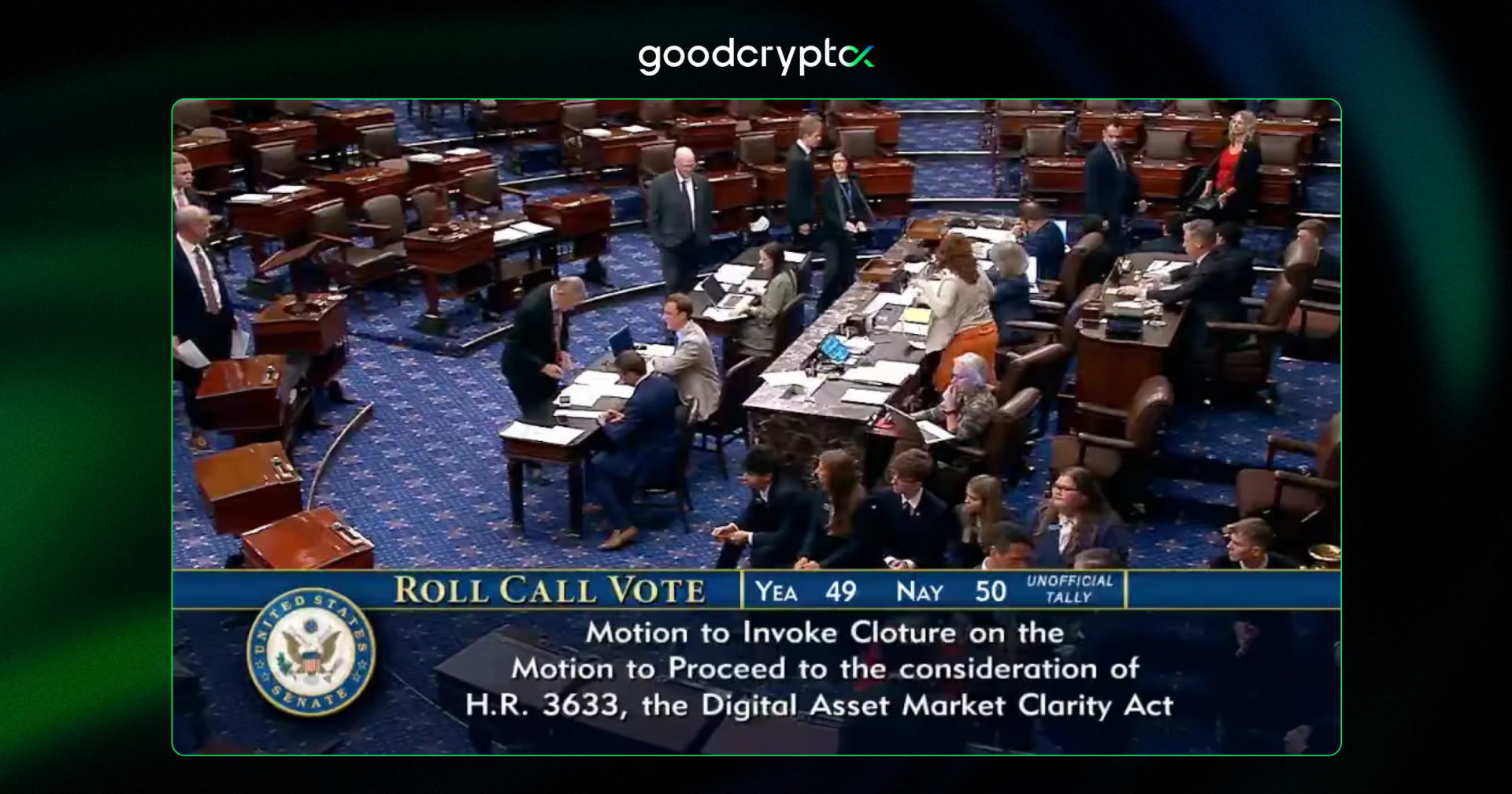
Source: U.S. Senate
The bill stumbled on a handful of unresolved sections, most notably the ethics provisions meant to limit senior government officials’ crypto business ties, and the closer the process got to November’s midterm elections, the harder bipartisan consensus became to hold. Even several Republicans voted no, leaving the bill short of a simple majority, let alone the 60-vote threshold.
“Do not let this day be the day we handed our future to someone else because we were too afraid to finish what we started,” said Senator Cynthia Lummis, the bill’s lead Republican sponsor, in a floor speech before the vote.
The defeat doesn’t end the effort, but it significantly complicates it. The SEC and CFTC are moving forward on crypto rulemaking in the absence of legislation, though even Chair Paul Atkins has acknowledged that rules without a law behind them are easy to reverse. The current Congress winds down at year-end, and the incoming one, potentially with Democrats holding one or both chambers, is unlikely to treat crypto market structure as a top priority.
The industry’s super PACs, led by Fairshake, now face decisions about how to treat the no voters in the final stretch before November’s elections. The Clarity Act’s failure is a significant setback, though the earlier passage of the GENIUS Act on stablecoins remains a meaningful win the industry can point to.
Circle launches Arc blockchain, with CEO Jeremy Allaire calling it more consequential than USDC
Circle launched Arc on Wednesday, its biggest move beyond issuing USDC, and CEO Jeremy Allaire wasn’t understating the ambition. “This is the most consequential major platform launch in our history,” he said, “and I think an even more consequential launch than USDC itself.”
Arc is designed as a general-purpose financial blockchain for payments, tokenized assets, lending, trading, and eventually commerce between AI agents. Circle built it around the friction points that have kept traditional institutions away from existing chains: configurable privacy for regulated entities, transaction fees paid in USDC rather than a volatile native token, sub-second finality, and a permissioned validator set.
The launch roster is notable. BlackRock, DTCC, Intercontinental Exchange, Mastercard, Standard Chartered, and Visa are among Arc’s founding validators. BNY, HSBC, and State Street are among 100+ institutions on or exploring the network. Uniswap and Aerodrome are live as trading venues, Aave and Morpho provide lending markets, and tokenized money market funds including BlackRock’s BUIDL and Circle’s own USYC are coming to the network.
Arc still has its own token. Circle completed the genesis mint of 10 billion ARC tokens this week, though Allaire stressed it isn’t publicly available yet and the mint doesn’t commit Circle to a public launch. A transition from proof of authority to proof of stake is being explored for 2027, which could give ARC a role in governance and security, while fees continue to be paid in USDC.
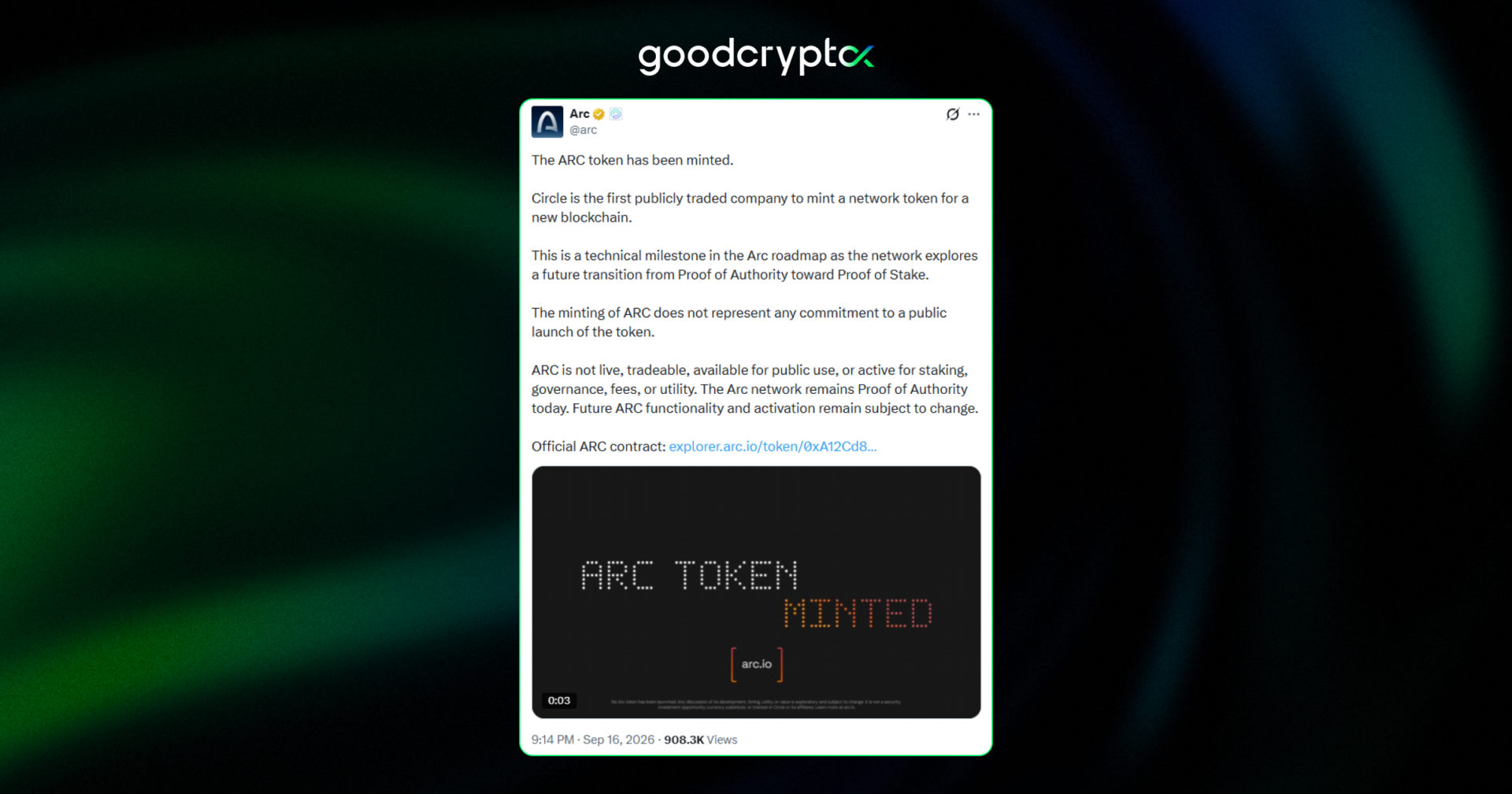
Source: X
The launch comes as Circle’s core stablecoin business faces growing competition. A consortium of 21 banks, including Bank of America, Citi, and Goldman Sachs, is preparing a dollar stablecoin for the first half of 2027, and Stripe is pushing deeper into crypto with its Open USD stablecoin and the Tempo blockchain. Allaire compared Circle’s approach to Google, building its own platform while keeping USDC widely distributed across competing networks. Arc, he said, is meant to become “one of the leading, if not the leading platform” as more financial activity moves onchain.
DCA bot vs. Grid bot on goodcryptoX
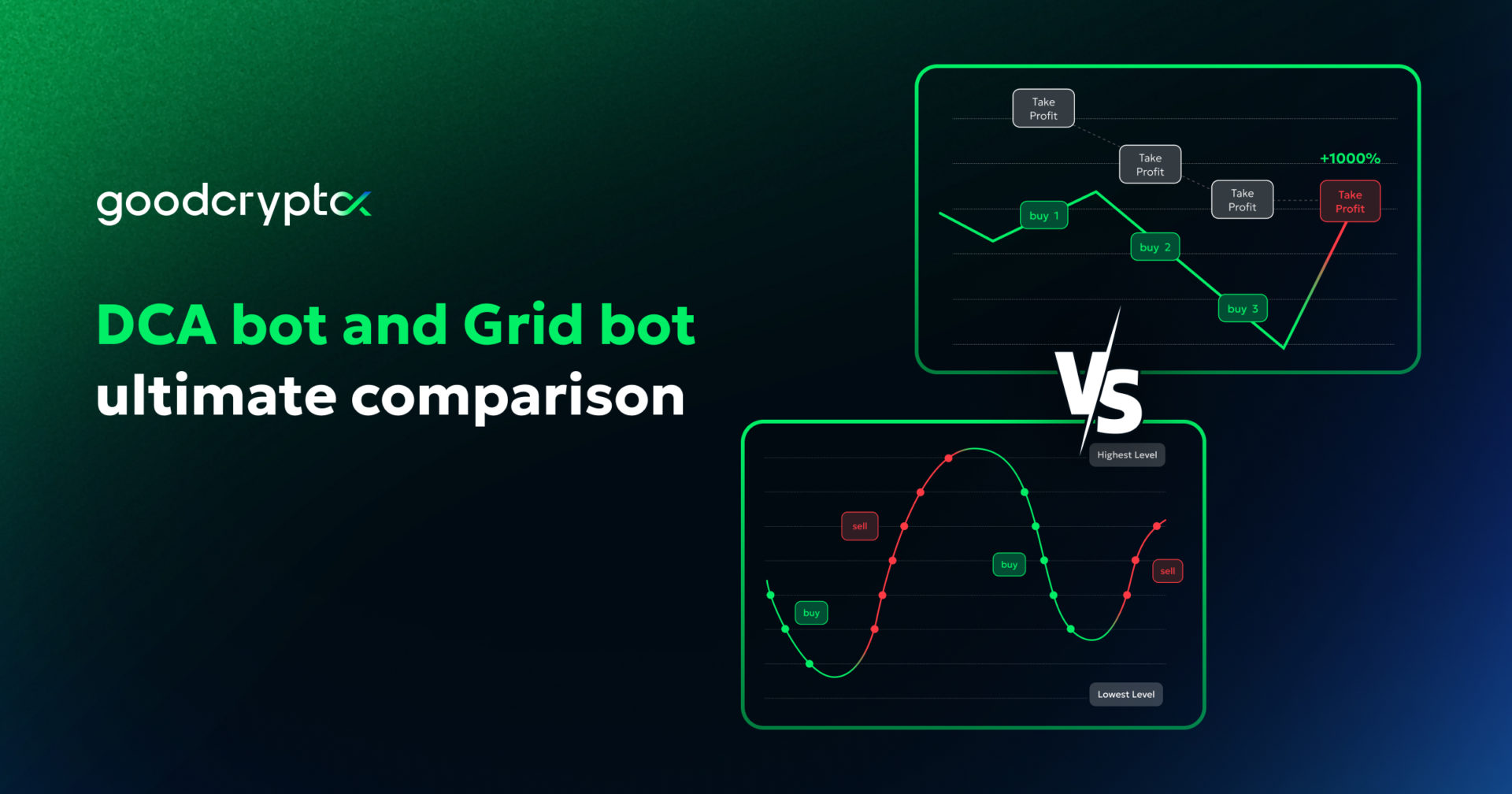
Two of the most battle-tested algo trading strategies, both built for volatility, but made to make money from it in fundamentally different ways. And knowing how they work and how to use them is what separates amateurs from pro traders.
Here’s what sets them apart:
- DCA bot: Averages down your entry automatically as price dips, and adjusts your take profit to help you turn profitable at a market rebound;
- Grid bot: Places a grid of buy and sell orders around the current price to profit from price fluctuations between support and resistance, even when the market looks slow;
- Choosing right: Your pick depends on market conditions, risk tolerance, and your chosen strategy.
Want to find out how to pick the correct one? We break down both strategies, real use cases, and when to use each 👇
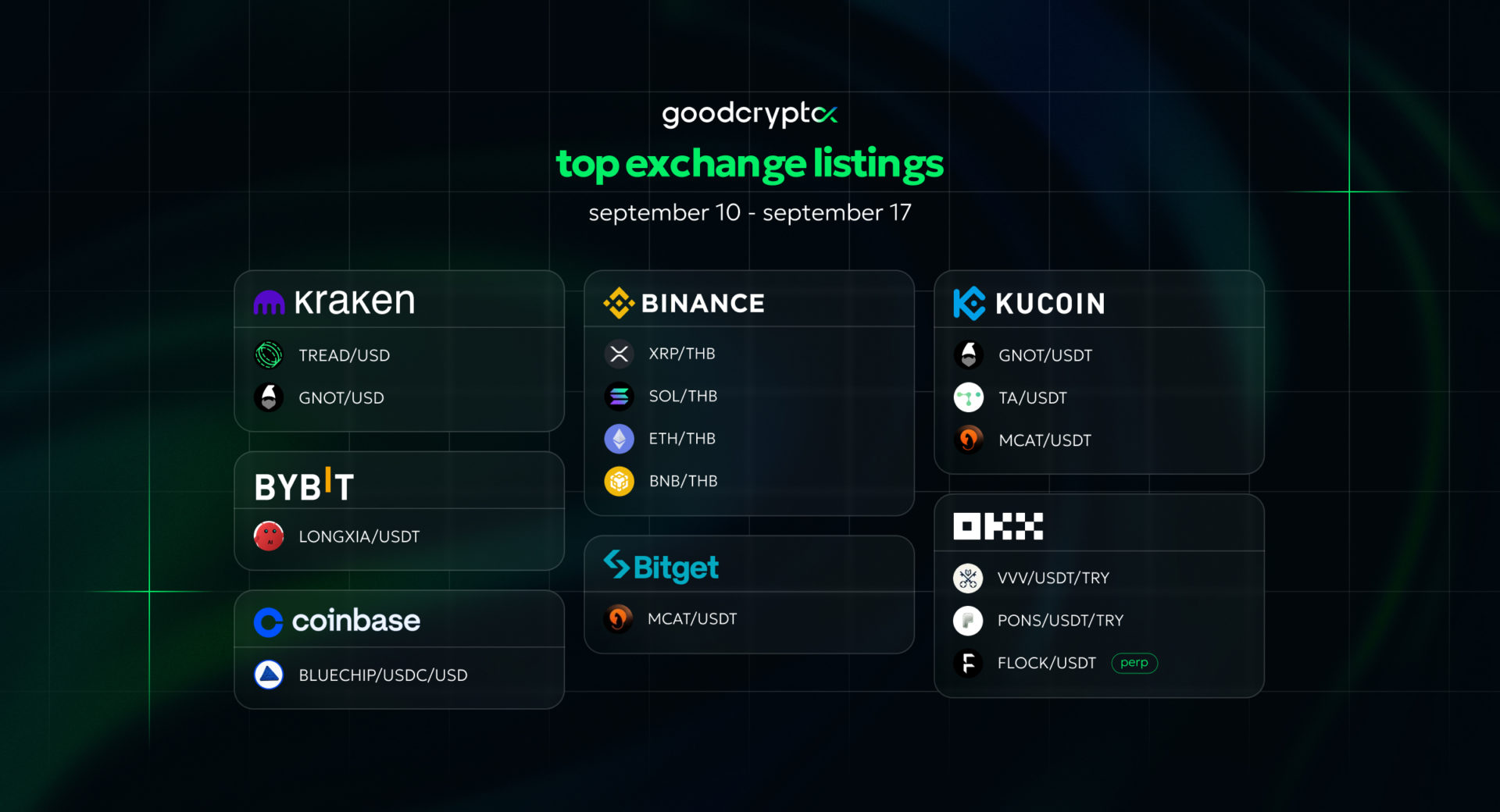
Receive an instant notification when a new coin is listed with the goodcryptoX PRO plan.
top crypto meme of the week

We hope this digest was valuable and informative for you! If you want to be the first to receive new crypto insights and stay up-to-date with the market, follow us on Twitter or Telegram. Become a better trader with the goodcryptoX app!