

Late again. I’ll spare you the excuses this time, because the month itself is the bigger story. So let me just say it plainly: it was a bad month, probably the bleakest since we started. Though not entirely bad.
the market
For a few weeks in May, it actually looked like the worst might be behind us. The Iran war was winding down – a US-Iran deal took the oil shock off the table – and the Clarity Act, crypto’s one credible near-term catalyst, looked a step away from coming to life.
Then the market remembered inflation. CPI printed a three-year high, and the new Fed chair turned out to be a lot less dovish than everyone had penciled in. At his first meeting, the dot plot flipped from rate cuts to a likely hike. Risk appetite cooled across the board.
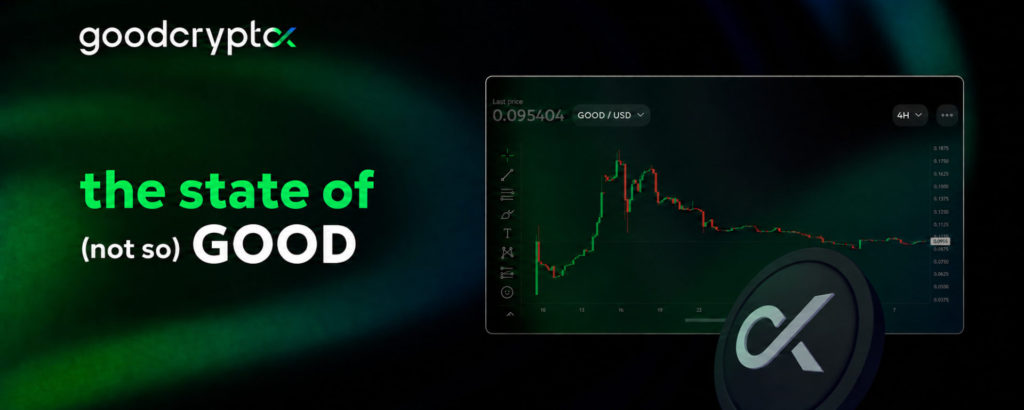
And here’s the part that matters for us. Even as the broad market mostly shrugged it off – equities are back near all-time highs – crypto kept sliding. That split traces back to October, when a single day wiped out around $19B in leverage and took most coins down 50%+ in minutes. As someone put it at the time, crypto wasn’t broken that day – but the narrative was. Stocks recovered from there. Crypto didn’t. It decoupled, and not in a good way: it went down while everything else went up. Bitcoin is now off more than 50% from its October top, back to lows last seen in late 2024. 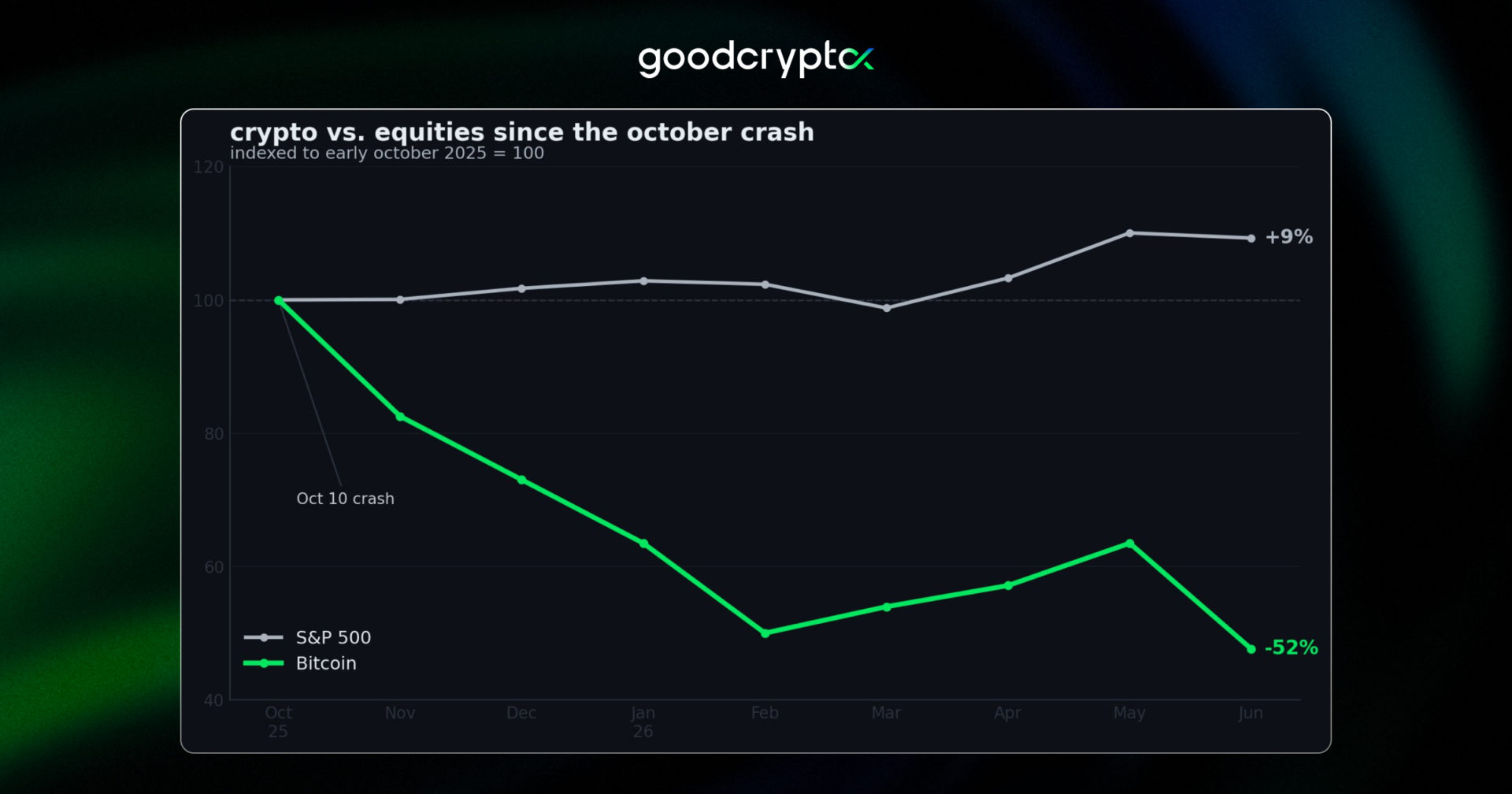
The market has stopped pretending. Until a new narrative shows up, every flicker of recovery keeps getting sold.
One thing of ours held out. The crash took trading volumes down with it, not just prices – across crypto, activity dried up. But Hyperliquid volume inside goodcryptoX held most of last month’s jump: off the mid-May peak, yes, but still well above where it sat two months ago, the cumulative now past $23M, and the number of active wallets trading actually rising while the rest of the market’s fell. That’s the infrastructure work starting to show where it counts.
revenue sharing
The pool of GOOD tokens earning revenue share kept growing – from ~22M to over 26M tokens, another ~4M added, and still the single biggest driver in the whole system.
But for the first time, the people’s side nearly stalled. Eligible wallets crept from 224 to 229 – still growth, just barely, against the ~10% a month we were adding earlier. The tokens kept coming; new faces, not so many as before. After months of this ecosystem growing straight through the drawdown, that’s the first real crack – existing holders still topping up, but the stream of newcomers thinned out. Concentration, at least, eased a bit: the largest single wallet came back from ~22% to ~19% after last month’s consolidation.
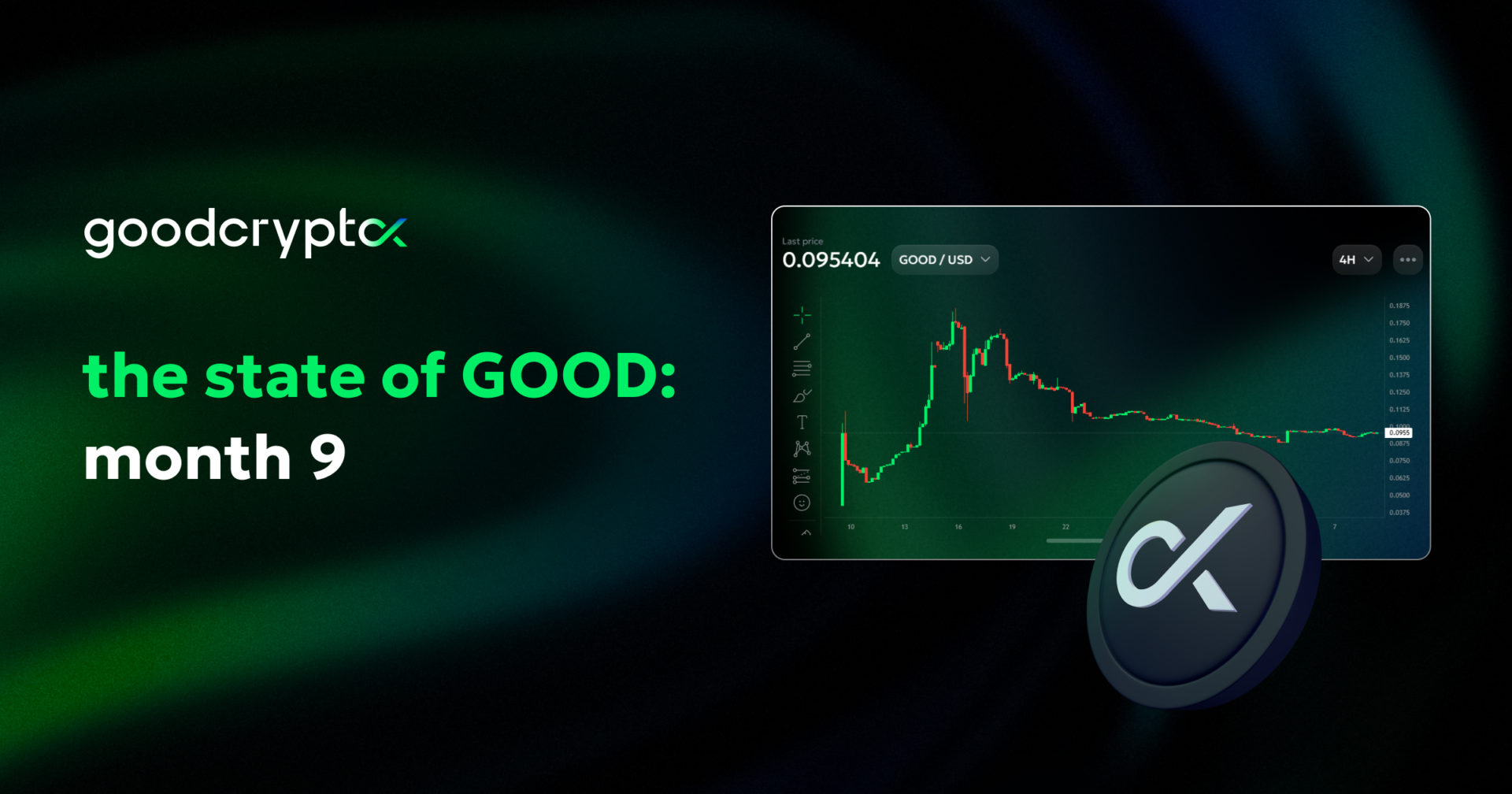
But it wasn’t all bad. Yields went the other way – up: 30-day APY climbed back to ~25%, the highest in months 💪. Dollar payouts to the pool grew roughly 20% – but GOOD being down ~45% also did help (a lot). Call it two-thirds the price, a third real growth – the mirror image of last month. It is not a bad thing, mind, it is the tokenomics design doing what it should when the market falls.
So what a GOOD HODLer should actually be looking at right now?
I usually don’t comment on price, but this month leaves little choice. If you sell here, you lock in the drop. If you hold, the payouts keep landing – they never stopped – and you’re getting paid to wait, which beats holding a coin that only went down and handed you nothing back. And if you add, you lock in that 30% APY and position yourself for the next cycle in the best possible way.
When the market turns (and it will), it might turn out to be a generational opportunity.
In other news, auto-compound is still doing its quiet but important work in the background: ~93% of eligible wallets compounding, which has now bought back over 1.5M GOOD from the market since launch.
burns
If the price is the part that hurts to watch this month, burns are the part that didn’t. 🔥
Both daily and monthly burns hit record highs. The monthly burn (May revenue) came in just under 200K GOOD – by far the largest ever, nearly double the old record. Daily burns hit their highest level, too.
The main driver is the same one dragging on everything else: price (though the 20% DEX revenue increase also did not hurt).
Higher DEX revenue + a much lower price = a lot more tokens burned. It runs in reverse just as cleanly – higher price, stronger revenue, and the dollar burn grows even as the token count compresses. Either direction, supply tightens. By design.
And the milestone: on June 21, we crossed 1,000,000 GOOD burned. 🔥 We’d quietly figured we’d reach a million somewhere around the end of year one (so in September 2026). We’re well past it already, and climbing fast – cumulative is now over 1.19M.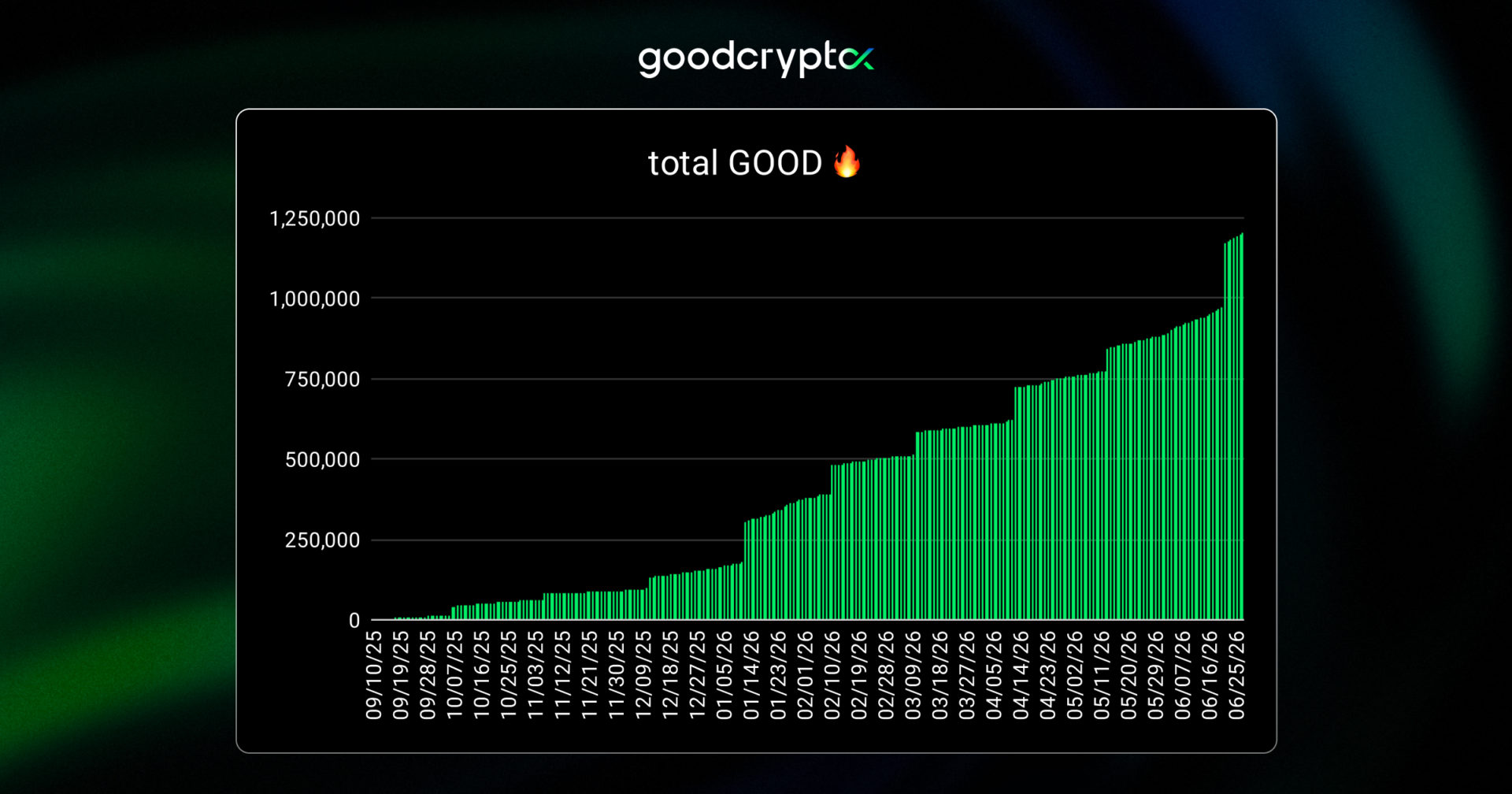
Burns don’t care about sentiment. They follow activity and price, and right now, both the activity and the low price are feeding them. This is the part of the design that gets louder exactly when everything else goes quiet.
the product
We’ve spent the last month getting DEX limit orders ready on Solana, the prerequisite for the DEX Grid bot, and were a button-push from shipping. Then, live-testing right before release, we saw enough to cancel it. The only protocol for offering true limit orders with certainty of price is Jupiter Limit V1, and those orders only matter if someone fills them. Unlike the EVM world – where open keeper networks fill a limit order for anyone – Jupiter’s V1 fills run through their own service, and it works, but not 100%: fine on SOL itself, intermittent on most tokens, dead on new ones. We went back and forth with their team, but it just isn’t nearly reliable enough to put real money on, let alone build a Grid bot on top of.
Calling it off wasn’t free. A finished, fully-integrated feature – a month-plus of work across the team – shelved, plus another week to cleanly strip it back out and revert to stop-market orders, and a delayed release. At the worst possible time. The knock-on: the DEX Grid bot, a port away once limit orders landed, can’t ship on the current path – it needs the price certainty that only true limit orders provide, and we don’t have a reliable source of those right now. A more versatile Grid bot that doesn’t need that certainty is on the roadmap, but further out.
That’s the bad news. The good news came out of it. Being forced to tear up that stretch of the roadmap made us rethink the whole thing, and we came out stronger. The 💎Sniper bot was always built as more than just a bot, but a foundational piece of our architecture (which is a big part of why it took as long as it did) – and that foundation, plus a hard look at other products in the space, is what our new near-term product roadmap builds on. Three tracks from here:
- Signal / TradingView strategy bot. A v1 is coming very soon to CEXs and DEXs, likely with the next app release. It takes a signal from a trading strategy and fully automates entries, exits, and position management for a single position. A far more versatile (with all the bells and whistles and more), multi-coin v2 follows later, built on the 💎Sniper stack.
- The 💎 Sniper, upgraded and ported to CEXs. The same engine becomes a multi-coin DCA bot – “buy coins on these signals, DCA them if they drop” – and ports to centralized exchanges, with technical-indicator entries (RSI, MACD, crosses etc.) standing in for the DEX screener. That multi-coin DCA bot is the base the v2 Signal bot grows out of.
- Backtesting suite. A connected set of tools to make getting started (and trading more) easier: backtested, ready-made setups you can copy in one click for every bot, plus backtesting and optimization built into the bots themselves – so a setup you create can be tested and profit-optimized before launch.
The Signal and multi-coin DCA bots are core offerings for many of our CEX competitors, and they simply do not exist in the DEX space. We believe they’ll make our product offering much stronger. And the conversion suite is something that will transform the user experience.
zooming out
Tops are marked by euphoria – parabolic candles, everyone a genius. Bottoms are marked by the opposite: prices falling off a cliff, despair setting in. This was the first month we actually felt that despair, and from the looks of it, we weren’t alone – the whole market felt it. That might not be the exact bottom. But it’s the closest thing to a bottom signal we’ve had. From here, it’s roughly binary: either we’re very near the floor, or crypto doesn’t make it. If you believe crypto survives – and we do – then we’re probably a lot closer to the bottom than the top.
The other consolation isn’t a feeling, it’s the flywheel. GOOD token economy did exactly what it was built to do this month: yield rose as price fell, and burns went from a footnote to something that actually moves supply. When the market turns, those same mechanics run the other way, and the numbers get a lot more fun. Until then, this is about the cheapest these tokens – and the fee discounts that come with holding them – have been in a long time.
Our run-rate this year is well below last year’s. The damage is real, and we won’t pretend otherwise. But the foundation underneath – the community, the token economy, the product – is stronger than it was a cycle ago.
So a recovery doesn’t just get us back to where we were; it should take us (much) further.
As a team, we feel this market as much as anyone holding through it – some days more. But the only direction that’s ever made sense here is forward, so we keep building.
stay GOOD